

Effect of Thinning and Ground-based Skidding on Soil Mite Diversity in Temperate Beech Forests
doi: https://doi.org/10.5552/crojfe.2027.4559
volume: issue, issue:
pp: 15
- Author(s):
-
- Latterini Francesco
- Horodecki Paweł
- Jagodziński Andrzej M.
- Kamczyc Jacek
- Ashwood Frank
- Harvey Campbell
- Venanzi Rachele
- Picchio Rodolfo
- Dyderski Marcik K.
- Article category:
- Original scientific paper
- Keywords:
- forest operations, timber harvesting, Mesostigmata, soil disturbance, soil compaction
Abstract
HTML
Forest operations, particularly ground-based skidding, are known to cause soil disturbances, yet their long-term impact on soil biological communities remains understudied. The goal of this study was to assess the effects of thinning and skidding on Mesostigmata mite communities in Polish beech forests, analyzing soil disturbance in skid trails, undisturbed harvested areas, and unharvested control sites. This study is especially needed in Polish beech forests, considering that recently both the shift towards continuous cover forestry and the increasing demand for beech timber have fostered the shortening of the re-entry intervals between two consecutive logging operations in the same forest management unit. Further to the above, the aim of this study was to leverage a well-recognized indicator of soil health, i.e. mite biodiversity, to check both the short-term consequences of ground-based forest operations and the related recovery times after harvesting. A total of 670 individual mites from 49 taxa were identified, with significant reductions in abundance and diversity in the disturbed soil. Mite abundance in recently established skid trails was approximately 80% lower than in unharvested control sites, while species richness and diversity were reduced fivefold. Even five years after logging, mite abundance and diversity remained three times lower than in unharvested stands, indicating prolonged recovery. Unexpectedly, uncompacted soil within harvested blocks also showed a 50–75% decrease in mite diversity, suggesting that thinning alone can significantly affect soil mites. Statistical analyses revealed strong correlations between mite abundance and soil penetration resistance and organic matter content, emphasizing the role of both compaction and organic matter depletion in shaping soil biodiversity. Given that the current re-entry interval is insufficient for biological recovery, forest management should consider increasing the re-entry interval, implementing further soil protection measures to skid trails, and assessing alternative extraction methods, e.g. forwarding. These findings highlight how integrating soil biological indicators into forestry operations planning can lead to lowered impacts on soil and soil biota.
Effect of Thinning and Ground-based Skidding on Soil Mite Diversity in Temperate Beech Forests
Francesco Latterini, Paweł Horodecki, Andrzej M. Jagodziński, Jacek Kamczyc, Frank Ashwood, Campbell Harvey, Rachele Venanzi, Rodolfo Picchio, Marcin K. Dyderski
https://doi.org/10.5552/crojfe.2027.4559
Abstract
Forest operations, particularly ground-based skidding, are known to cause soil disturbances, yet their long-term impact on soil biological communities remains understudied. The goal of this study was to assess the effects of thinning and skidding on Mesostigmata mite communities in Polish beech forests, analyzing soil disturbance in skid trails, undisturbed harvested areas, and unharvested control sites. This study is especially needed in Polish beech forests, considering that recently both the shift towards continuous cover forestry and the increasing demand for beech timber have fostered the shortening of the re-entry intervals between two consecutive logging operations in the same forest management unit. Further to the above, the aim of this study was to leverage a well-recognized indicator of soil health, i.e. mite biodiversity, to check both the short-term consequences of ground-based forest operations and the related recovery times after harvesting. A total of 670 individual mites from 49 taxa were identified, with significant reductions in abundance and diversity in the disturbed soil. Mite abundance in recently established skid trails was approximately 80% lower than in unharvested control sites, while species richness and diversity were reduced fivefold. Even five years after logging, mite abundance and diversity remained three times lower than in unharvested stands, indicating prolonged recovery. Unexpectedly, uncompacted soil within harvested blocks also showed a 50–75% decrease in mite diversity, suggesting that thinning alone can significantly affect soil mites. Statistical analyses revealed strong correlations between mite abundance and soil penetration resistance and organic matter content, emphasizing the role of both compaction and organic matter depletion in shaping soil biodiversity. Given that the current re-entry interval is insufficient for biological recovery, forest management should consider increasing the re-entry interval, implementing further soil protection measures to skid trails, and assessing alternative extraction methods, e.g. forwarding. These findings highlight how integrating soil biological indicators into forestry operations planning can lead to lowered impacts on soil and soil biota.
Keywords: forest operations, timber harvesting, Mesostigmata, soil disturbance, soil compaction
1. Introduction
Protecting forest soil is fundamental to achieving sustainable forest management (Filothei and Petros 2023, Engler et al. 2024, Latterini et al. 2025b), as emphasized by the latest forestry and biodiversity strategies introduced by the European Union (European Commission 2020, 2021). Ground-based logging operations are widely known to cause disturbances to forest soil (Labelle and Jaeger 2011, Borz et al. 2023, Richmond et al. 2023). The primary machinery impacts on the soil include compaction and rutting (Grünberg et al. 2023, Nazari et al. 2023, Latterini et al. 2025d,).
Compaction occurs when mechanical forces exerted on the soil compress the soil matrix, reducing pore space (Labelle and Jaeger 2012). This effect is intensified by repeated passes of machinery, especially in moist soils (Schönauer et al. 2022, Salmivaara et al. 2024, Latterini et al. 2025c,). As such, ground-based forest operations could alter key forest soil functions by increasing soil strength and bulk density (Nazari et al. 2021), while simultaneously reducing the diversity of the soil biota (Klein‐Raufhake et al. 2024). The consequences can include reduced oxygen availability, elevated surface water runoff, soil erosion, and sedimentation (Picchio et al. 2021). Ultimately, these consequences are likely to hinder tree and root growth (Latterini et al. 2024a), thus compromising stand productivity (Labelle and Kammermeier 2019).
The majority of studies have focused on the consequences of ground-based logging on the physical properties of the soil, mostly in terms of compaction and rutting (Nazari et al. 2023, Latterini et al. 2025a). Studies focusing on disturbance to soil biota are a novel approach (Latterini et al. 2024d). Whilst it is well known that ground-based logging could alter forest soils, how much time is needed for forest soils to recover after disturbance is much less understood (DeArmond et al. 2021). Recovery is indeed a complex process that could take a few years up to decades depending on the level of initial disturbance, soil features, and environmental conditions (Tavankar et al. 2022, DeArmond et al. 2024). Soil microarthropods have long been considered as suitable bioindicators for the assessment of machinery-induced soil disturbance related to logging operations (Engler et al. 2024).
Soil mites and their biodiversity have previously been used to assess forest soil health (Kamczyc et al. 2023) and disturbance to the forest ecosystems (Lóšková et al. 2013, Junggebauer et al. 2024). Considering their role in the soil food web and their various behavioral, trophic, and ecological traits, soil mesostigmatid mite communities are good bioindicators of soil condition (Urbanowski et al. 2021). Several studies have used Mesostigmata or other mite groups as bioindicators of harvesting disturbance in terms of canopy cover alteration, but these have not considered the effects of forest machinery, even if directly linked. Meehan et al. (2019) found soil mites as valuable indicators of forest harvesting-based disturbance in boreal stands, with decreased biodiversity in harvested stands compared to unharvested ones. Gibson et al. (2022) reported decreased mite abundance after thinning, mastication, and prescribed fire in Pinus ponderosa forests in the US. However, very few studies have used soil Mesostigmata diversity as a metric to assess machinery-induced soil disturbance and recovery time after logging. To our knowledge, there is only one study that has used mites as a bioindicator for assessing machinery-induced soil disturbance. Lindo and Visser (2004) used mite (Oribatida and Mesostigmata) abundance and community composition to assess the effects of clear-cutting by fully mechanized harvesting systems in spruce and aspen stands in Canada. Their findings reported decreased mite abundance in compacted soil, but nonsignificant variation in terms of diversity indices compared to unlogged stands (Lindo and Visser 2004).
In recent years an increase in harvesting frequencies has been observed throughout Eastern and Central Europe (Suvanto et al. 2025). In countries such as Poland, this has led to a reduction in re-entry intervals in beech (Fagus sylvatica L.) logging sites. The previously used 10-year interval has been often reduced to 5-years, to tackle increasing demand for wood for the internal market and international export (Michalski et al. 2023, Mazur and Winkler 2025), as well as to align with the shift towards continuous cover forestry, which is based on low-intensity harvesting interventions carried out at shorter intervals compared with typical even-aged management (Puettmann et al. 2015). This raises the question of whether this reduced time frame is sufficient to ensure the recovery of soils and/or soil biota before logging re-entry.
In this study, we used Mesostigmata mite diversity as an indicator for assessing soil disturbance related to ground-based logging, and the associated recovery time. Specifically, we hypothesized that:
- the soil affected by the passage of the machinery (skid trail network) would show lower abundance and diversity of Mesostigmata
- a 5-year period is insufficient to restore Mesostigmata abundance and diversity to the pre-harvesting level
- decreased abundance and diversity of Mesostigmata are related to the soil compaction and soil organic matter depletion which typically occurs in skid trails.
2. Materials and Methods
2.1 Study Areas and Experimental Design
Two study areas were selected in Poland: one located in a lowland region in northern Poland (Area 1 – Kolbudy Forest District) and the other located in a mountainous region in southern Poland (Area 2 – Sucha Forest District). Area 1 is characterized by Arenosols with a sandy-loamy texture, an average annual temperature of 7°C, and an average annual precipitation of 685 mm. In contrast, Area 2 has silty-loamy Leptosols, an average annual temperature of 5.5°C, and an average annual precipitation of 1000 mm.
Both study areas include a chronosequence of three beech cutting blocks: one logged in 2021 (NEW), one logged in 2017 (OLD), and a control block which has remained unharvested for the past 20 years (CON). These locations were chosen as they are representative examples of temperate European beech forests, found in both lowland and highland regions (Durrant et al. 2016). All of the cutting blocks are even-aged beech forests, with beech dominating the stand basal area, and are actively managed using the shelterwood method as common all across Europe. The surface of the cutting blocks ranged from 5 to 12 hectares. The same harvesting system, the Tree-Length System (TLS), was employed in the cutting blocks logged in 2021 and 2017. This system involves felling and delimbing trees at the site using chainsaws, followed by the extraction of full-length trees with a cable skidder, as is common in Poland and Central Europe. In both study areas, timber extraction was carried out using the LKT 81ITL skidder (Bratislava, Slovakia), equipped with a 93 kW engine, two 80 kN winches, and an operational weight of 8.9 tons. The logging operations in all cutting blocks involved thinning from below, removing approximately 35% of the standing biomass.
Building on the methodology of Latterini et al. (2023), we evaluated machinery-induced disturbance by comparing soil properties in disturbed areas (DIST; skid trails) with those in undisturbed areas (UND; soil not directly affected by machine traffic at least 2 m far from the edge of the skid trails) and control areas (CON; unharvested stands; Fig. 1). In addition, comparisons between undisturbed areas and control sites allowed us to assess the effects of silvicultural treatments on soil properties. Applying this experimental framework to cutting blocks harvested in different years enabled us to examine the recovery of soil and soil biota after logging. A 5-year interval was selected because it corresponds to the typical time between successive logging operations within the same cutting block. The study design included five treatments: DIST_NEW, DIST_OLD, UND_NEW, UND_OLD, and CON. As no primary skid trails were present in the investigated cutting blocks, the analysis focused exclusively on soil disturbance along secondary and tertiary skid trails, which were subjected to between one and ten machine passes during logging operations (DeArmond et al. 2021). After logging was completed, these skid trails were closed to any further traffic (Fig. 1).
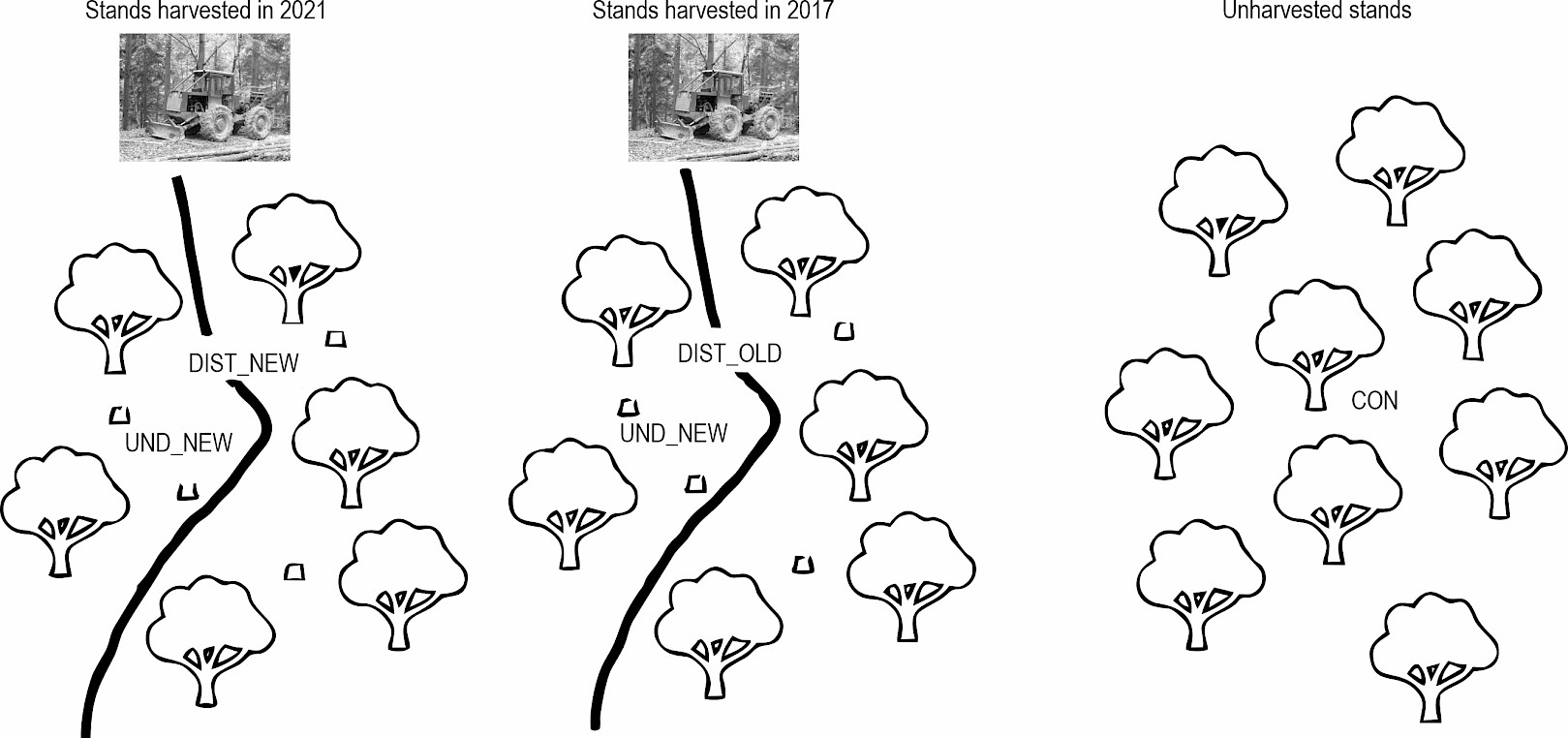
Fig. 1 Experimental design. The soil in the harvested stands (in both 2021 and 2017) is divided into disturbed soil in the skid trails (DIST_NEW and DIST_OLD for 2021 and 2017, respectively) and undisturbed soil not affected by the passage of the machinery (UND_NEW and UND_OLD for 2021 and 2017, respectively). The unharvested control area is indicated by the abbreviation CON
2.2 Identification of Skid Trails
Before collecting data on the target soil features, the proportion of disturbed soil (DIST) in relation to the total area was evaluated in each cutting block. This involved setting up four linear transects, each measuring 1×50 m, within each logged cutting block using a compass and tape measure. Along these transects, disturbed soil was identified based on indicators such as crushed litter, ruts, or mixed soil (Marchi et al. 2016). The disturbed area was then expressed as a percentage of the total area covered by each transect. In the logged cutting blocks, the extent of soil disturbance caused by skidder passes ranged from 22 to 26%.
2.3 Soil Physicochemical Features
Field surveys were carried out in October 2022 across both study areas, and namely one year after harvesting the 2021 cutting blocks and five years after harvesting the 2017 cutting blocks. Measurements for each variable were conducted at designated sampling sites, enabling the development of models to link various soil characteristics.
To measure upper soil bulk density (at a depth of 5 cm), we utilized a specialized corer (Eijkelkamp, Zevenaar, Netherlands), collecting six soil samples per experimental treatment in Area 1 and nine samples per treatment in Area 2, resulting in a total of 75 samples. The difference in the number of samples reflected the larger size of the cutting blocks in Area 2 compared to Area 1. Samples were sealed in plastic bags and transported to the laboratory, where they were oven-dried at 105°C to obtain a constant (dry) mass. Bulk density (BD) was calculated by dividing the dry mass of the soil by the volume of the corer cylinder (100 cm³).
Additionally, a handheld penetrometer (Eijkelkamp, Zevenaar, Netherlands) was used to determine penetration resistance (MPa) in the top 2 cm of the soil. These measurements were linked to soil water-holding capacity, following the methodology proposed by Saxton et al. (1986). The number of measurements for penetration resistance matched those taken for bulk density.
For analyzing soil organic matter in the upper soil layers, an additional set of six samples per experimental treatment in Area 1 and nine in Area 2 were collected, also totaling 75 samples, taken using the same corer as for bulk density. Organic matter content was determined via 4-hour combustion at 400°C in a muffle incinerator, following the method described by Rosell et al. (2001).
2.4 Soil Mesostigmata
The impact on the biological components of forest soil was evaluated by examining the abundance and diversity of soil Mesostigmata. To extract Mesostigmata, six soil samples per experimental treatment were collected in Area 1, and nine samples in Area 2, resulting in a total of 75 samples. Soil samples also included the litter layer. Each sample measured 10×10×10 cm and was obtained using a specialized soil corer. After being transported to the laboratory, Mesostigmata were extracted from the samples using Berlese-Tüllgren funnels. The extracted specimens were then preserved in a solution consisting of 75% ethyl alcohol and 25% glycerol by volume. Mesostigmata were extracted from the alcohol solution and examined under a binocular microscope before being placed in Hoyer's medium. Specimens were identified using a Zeiss microscope (Zeiss Axio Scope.A1). Each was classified to the appropriate species level or higher taxonomic category based on the most recent specialist literature (Gwiazdowicz 2007, De Moraes et al. 2022).
2.5 Statistical Analysis
Data were analyzed using R software (R Development Core Team 2023). The effect of treatments on Mesostigmata mite species composition was assessed with Redundancy Analysis (RDA), implemented in the vegan package (Oksanen et al. 2013), as the environmental gradient was short. To avoid outliers caused by single occurrences of single species, only samples containing more than one species were included in this analysis (n=45). Regional dependency was accounted for by including region as a conditional term in the RDA formula.
The effect of treatment was formally evaluated by comparing the Akaike Information Criterion (AIC) of the constrained RDA model, including treatment, with that of an unconstrained ordination model (Principal Components Analysis, PCA) that included only the conditional term. The effect of soil characteristics was assessed in a similar way, starting from an RDA model containing all soil variables. Before analysis, collinearity among explanatory variables was checked using variance inflation factors (VIF), provided they were below 5 for all variables.
The strength and significance of species associations with particular treatment variants were examined using the IndVal method, implemented in the indicspecies package (Hartig 2016). The effects of treatment on mite species richness, Shannon diversity index, and abundance were analyzed using generalized linear mixed-effects models (GLMMs). For abundance and species richness, a negative binomial distribution was used because these variables were discrete and showed overdispersion, as confirmed by formal tests in the DHARMa package (Hartig 2016). The same tests confirmed that zero inflation was not an issue. For Shannon diversity, a Gaussian distribution was applied. All GLMMs were fitted using the glmmTMB package, with region included as a random intercept to account for spatial dependency. For each response variable, two separate models were developed to test the first and second hypotheses independently. The first model included treatment as the only fixed effect, whereas the second included all soil variables. Collinearity among predictors was again assessed using VIF. Models containing soil variables were then simplified by model reduction, with the aim of minimizing the corrected Akaike Information Criterion for small sample sizes (AICc), using the MuMIn package (Bartoń 2023). The models with the lowest AICc values were selected as the final models. For each final model, we also reported AICc0, defined as the AICc of the null (intercept-only) model. The effects of individual variables were visualized using marginal means and marginal responses, that is, predicted values based on fixed effects only, while holding all other predictors at their mean values and excluding random effects. These values were calculated using the ggeffects package (Lüdecke 2018).
3. Results
3.1 Mesostigmata Abundance and Diversity
670 individual mites were found, classified into 49 taxa and representing 13 families. The most abundant families were Veigaiidae (n=180 individuals), Parasitidae (n=139), Uropodidae (n=95), and Macrochelidae (n=86). The most abundant species were Veigaia nemorensis (n=172 mites), Olodiscus misella (n=61), Geholaspis pauperior, and Trachytes aegrota (both n=51). It is worth highlighting that all of the most abundant species are predatory, except Trachytes aegrota which is omnivorous. A comparison of RDA (including treatment) and PCA (without treatment) revealed that PCA had lower AIC (78.5 versus 81.88), indicating a lack of treatment effect on mite species composition (Fig. 2a). Points representing various treatments overlapped in an ordination space, showing a lack of clear patterns. The first and second axes explained 21.3% and 13.2% of variability, respectively, while the study site (conditional effect) explained 9.1%. Analysis of the impact of soil variables revealed that RDA with soil organic matter content only (Fig. 2b) had the lowest AIC (77.3). The effect of soil organic matter content on Mesostigmata mite species composition was statistically significant (df=1, F=3.188, p=0.001). Analysis of indicator value species revealed a statistically significant association only for the species Macrocheles montanus (IndVal=0.598, p=0.007), which occurred only in five control plots.
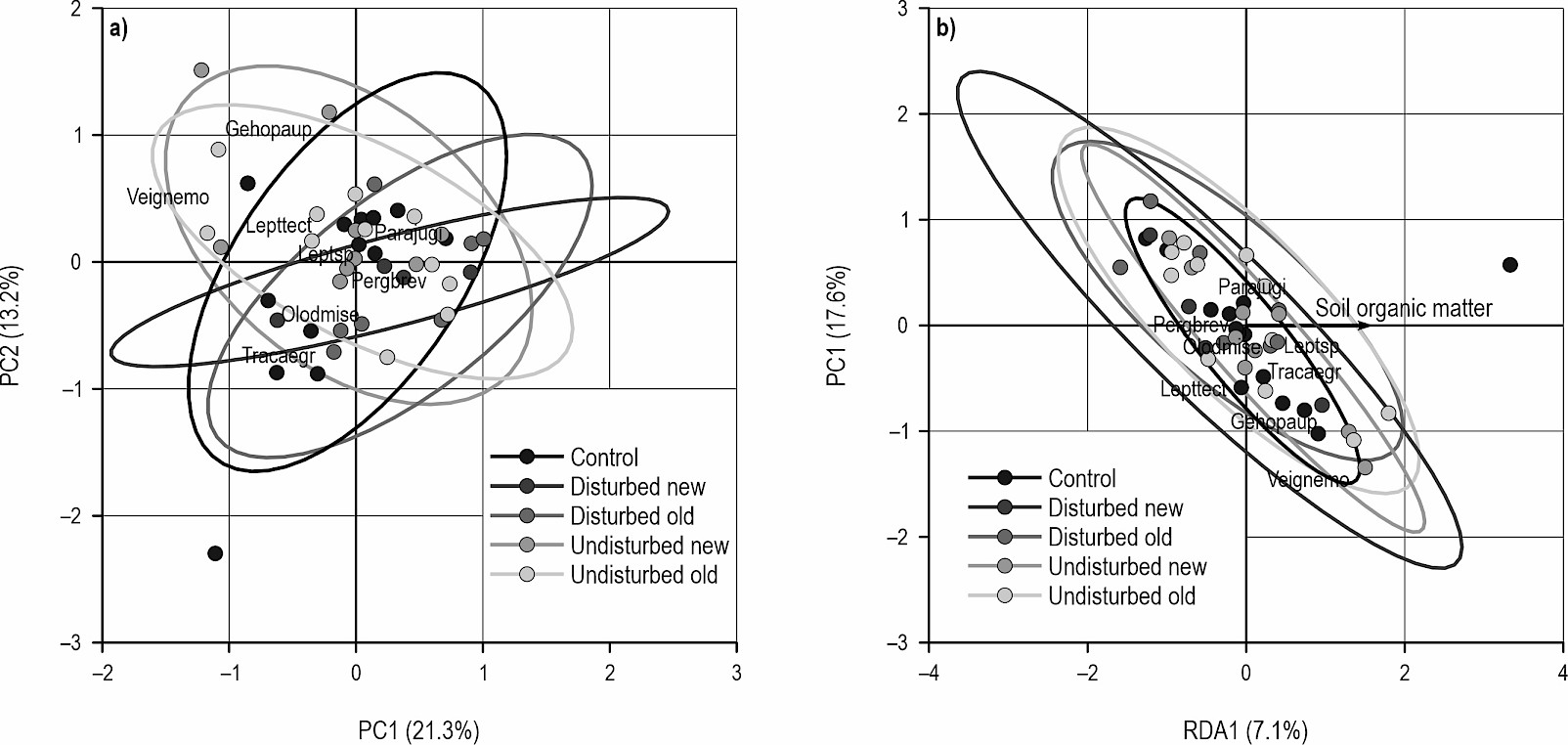
Fig. 2 Principal Components Analysis (a) and Redundancy Analysis (b) of Mesostigmata mite community composition in plots with more than one species (n=45): points represent study plots and italic labels – species scores (abbreviated, e.g. Veignemo=Veigaia nemorensis). Only species that occurred in >20% of plots were labelled for clarity
3.2 Influence of the Experimental Treatments
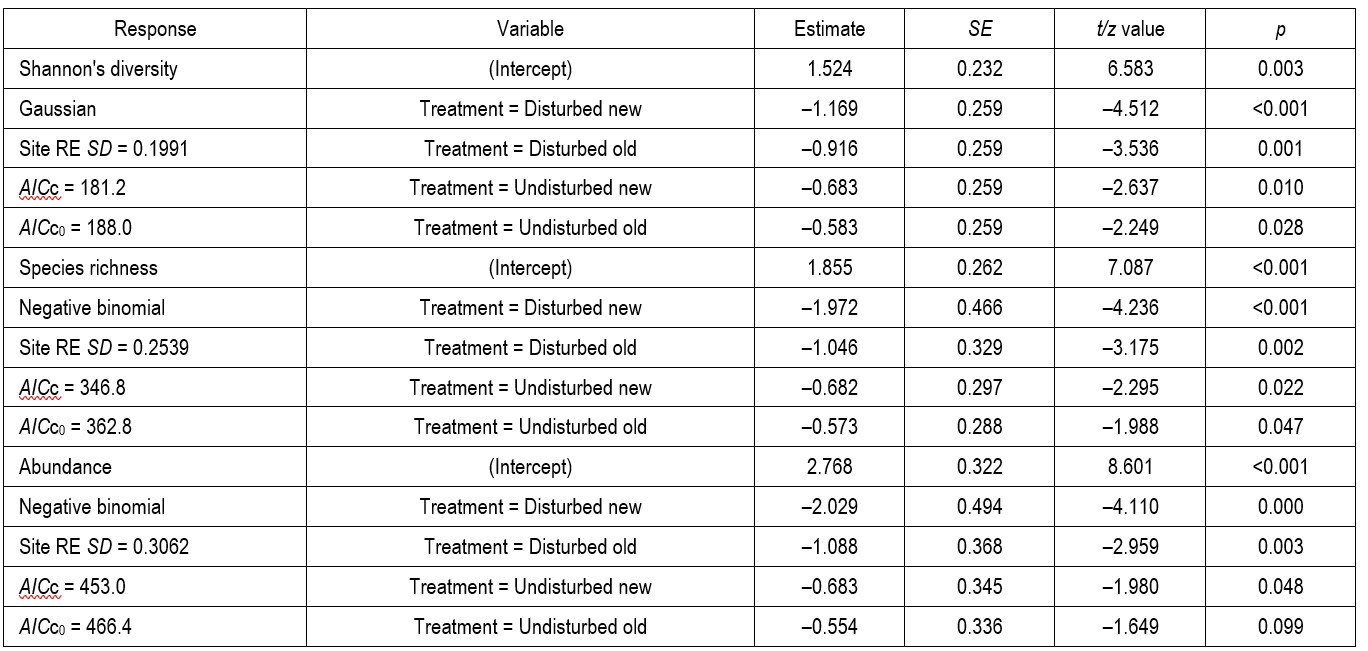
Statistically significant differences among treatments in Mesostigmata diversity, abundance, and species richness were found (Fig. 3, Table 1). Specifically, for each of the three variables a clear trend occurred whereby disturbed soil and soil temporally closer to harvesting (NEW treatments) had lower abundance and diversity detected. Control areas showed abundance, Shannon’s index, and species richness, which were five times higher than the soil in the skid trails established in 2021 (DIST_NEW). Disturbance persisted in the skid trails five years after harvesting (DIST_OLD) with values of abundance, Shannon’s index, and species richness three times lower than in the unharvested control areas. Surprisingly, the values of the treatments where soil was not directly impacted by machinery (UND_NEW and UND_OLD) also showed a very strong decrease in all of the investigated variables in comparison to the control treatment; all of the variables in the UND_NEW treatments were half that of the control. In the UND_OLD treatment, the values of abundance, Shannon’s index, and species richness were 75% lower than in the control area. Whilst substantial in terms of mean values, the differences observed between the soil in the skid trails and the soil not affected by the passage of the machinery, were not statistically significant.
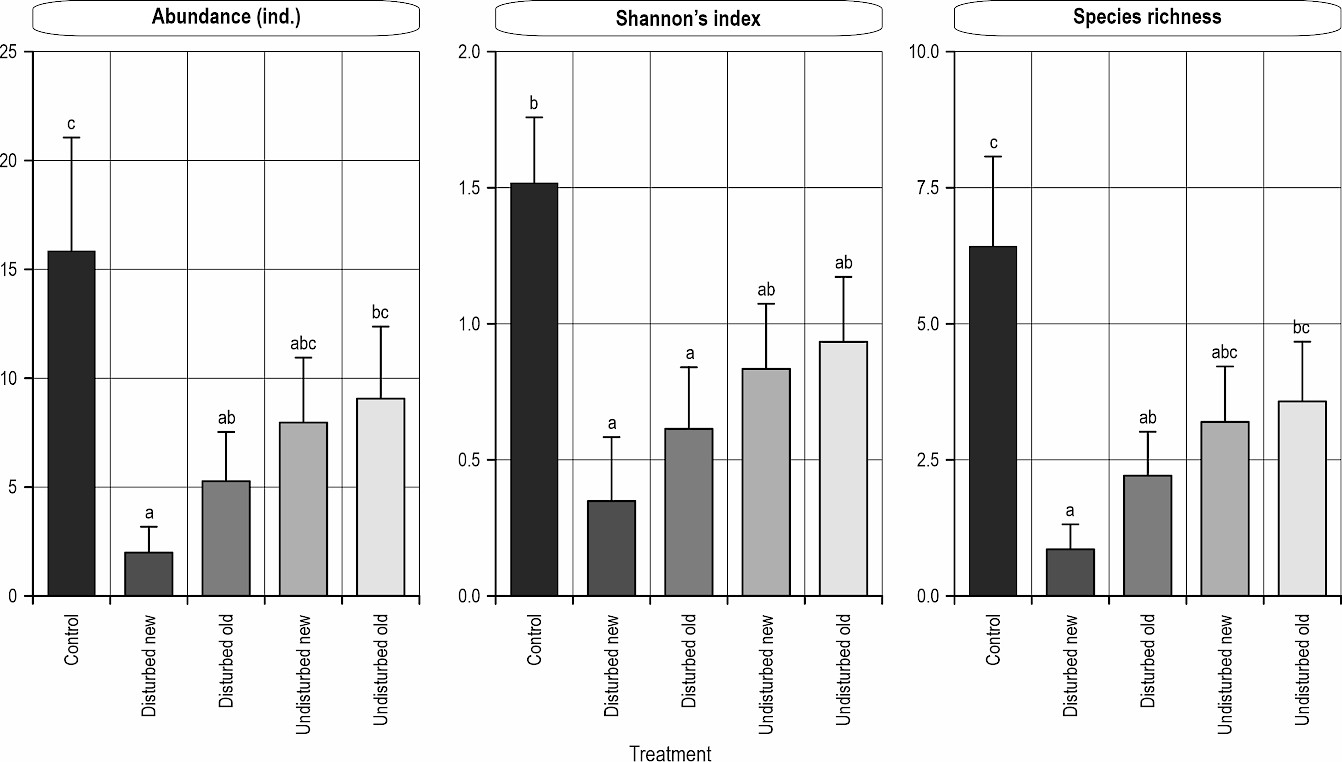
Fig. 3 Marginal mean values (+SE) of Mesostigmata mite abundance, diversity, and species richness estimated from models (Table 1). Treatments denoted with the same letter did not differ at p=0.05, according to Tukey’s posteriori test
Table 1 Generalized linear mixed-effect models explaining differences among treatments in Mesostigmata mite species richness and abundance (negative binomial distribution) and linear mixed-effect models for Shannon’s diversity index. Note that treatment = control is a reference (intercept) value
3.3 Mesostigmata Diversity and Soil Characteristics
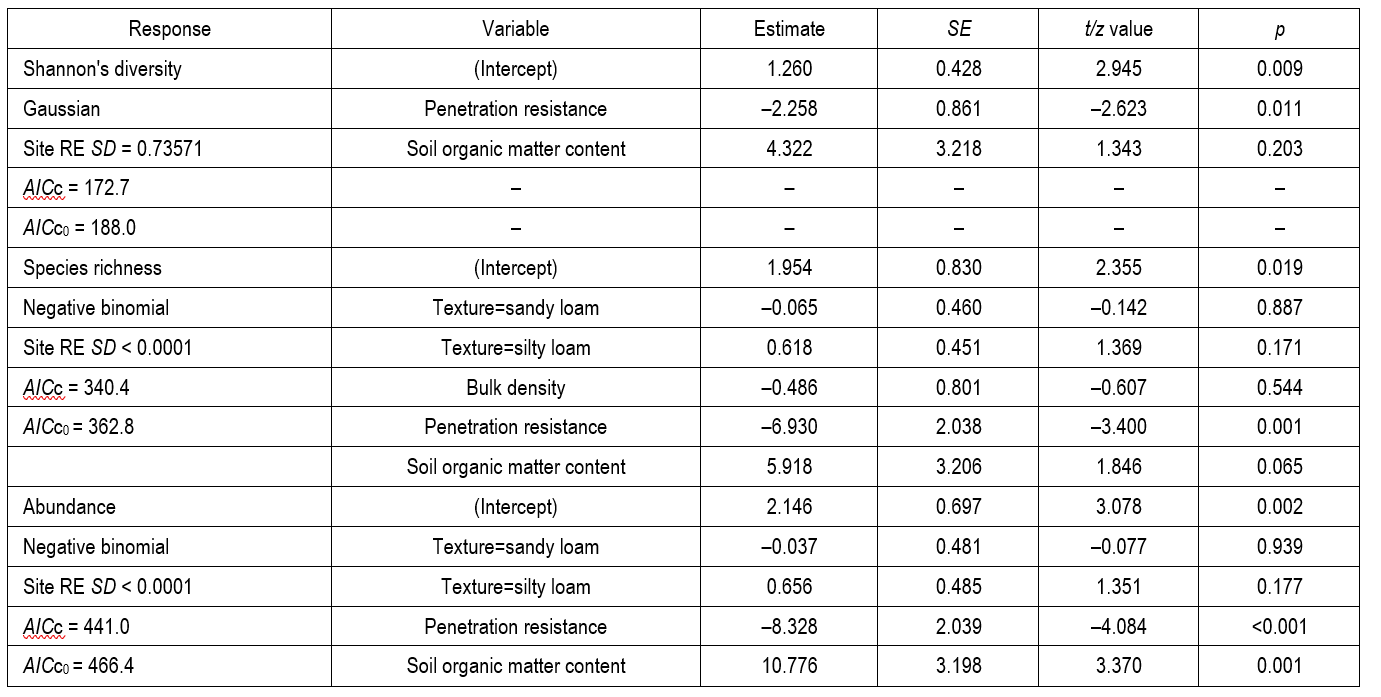
Significant relationships between soil characteristics and Mesostigmata mite diversity were found (Fig. 4, Table 2). Mite abundance decreased with increased penetration resistance (from 17 individuals at 0.15 MPa to 0.9 individuals at 0.5 MPa), but positively increased with soil organic matter content (from 2.8 at 0.02% to 9.1 at 0.13%). Abundance found in silty-loam soil was double that in sandy-loam textures. Likewise, Shannon’s diversity index decreased with increasing penetration resistance (from 0.54 at 0.15 MPa to 0.20 at 0.60 MPa) and positively increased with soil organic matter content. However, the latter was statistically insignificant. Mite species richness decreased with increasing penetration resistance (from 6.0 species at 0.15 MPa to 0.1 species at 0.6 MPa). Additionally, 2.5 times higher species richness was found in silty loam soils than in sandy loam soils. Effects of bulk density and soil organic matter content on mite species richness were statistically insignificant.
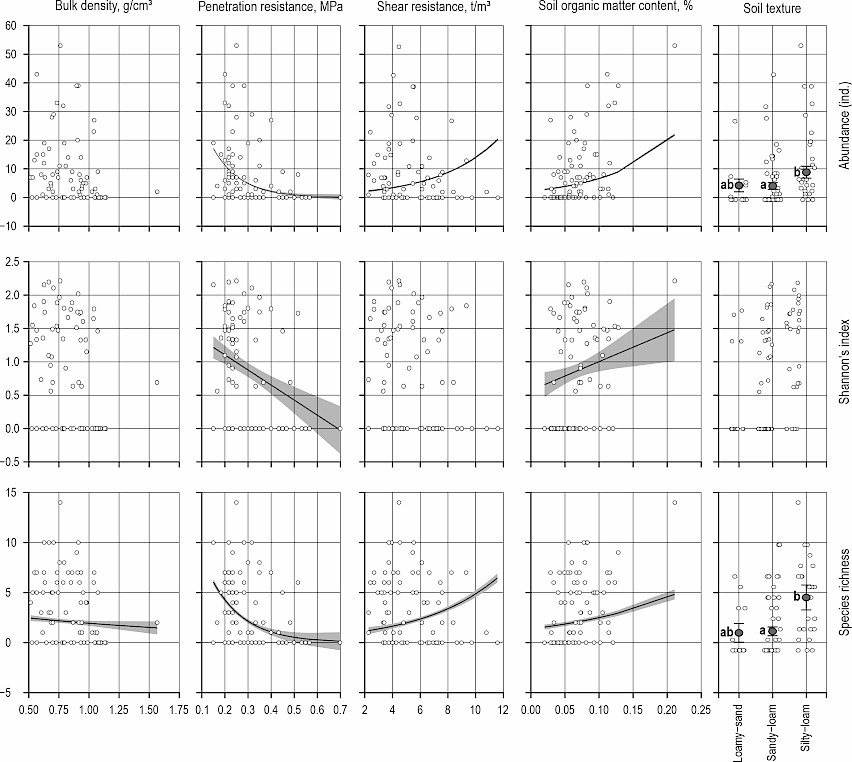
Fig. 4 Marginal responses of Mesostigmata mite abundance, diversity, and species richness models (Table 2). Empty dots represent measured values, line and full dots – prediction, grey area, and error bars – 95% confidence interval for prediction. Soil textures denoted with the same letter did not differ at p=0.05, according to Tukey’s posteriori test
Table 2 Generalized linear mixed-effect for Mesostigmata mite species richness and abundance (negative binomial distribution) and linear mixed-effect models for Shannon’s diversity index showing the dependence of Mesostigmata mite communities on soil characteristics. Note that texture = loamy sand is a reference (intercept) value
4. Discussion
The first two hypotheses, stating that the passage of machinery negatively affects Mesostigmata mite abundance and diversity, and that a 5-year period after harvesting is insufficient to restore these measures to pre-harvesting levels, were fully confirmed. The values of the investigated variables (abundance, Shannon’s index, and species richness) in the skid trails were significantly lower than in the control (unharvested) stands (Fig. 3, Table 1). Impacts from machinery passage were not found on Mesostigmata community composition, which may be explained by the dominance of four species comprising half of all identified individuals, and high turnover between samples. As total mite abundance was strongly reduced by machinery passage, the probability of detecting species other than the dominant ones decreased. That way, the core of species composition remained constant, which was also confirmed by the analysis of indicator species.
The magnitude of change in diversity and abundance was stronger in the newly established skid trails in 2021 (DIST_NEW), with values of the investigated variables at approximately 20% of those found in the control and practically halved in comparison to the soil not affected by the passage of the machinery. However, mite abundance and diversity remained much lower, (about one third) in the older skid trails established in the cutting blocks harvested in 2017 (DIST_OLD) than in the unharvested control stands. Surprisingly, strong alterations of Mesostigmata mite abundance and diversity indices were detected in the soil not directly disturbed by the passage of machinery in the harvested cutting blocks (UND_NEW and UND_OLD). Although the magnitude of change in comparison to the control area is lower than that of the skid trails, Mesostigmata mite abundance, Shannon’s index, and richness results were practically halved in the UND_NEW treatment and were 75% lower in the UND_OLD treatment. This highlights that a light canopy alteration such as thinning from below in a beech forest can also alter the soil mite community.
This finding contrasts with previous studies that evaluated the effects of thinning and ground-based skidding on soil microarthropod communities in beech forests using the QBS-ar index. These studies, conducted in Mediterranean beech forests in Italy, showed that the QBS-ar index decreased markedly on skid trails, approximately by half, compared with unharvested stands, whereas no alteration of the microarthropod community was detected in soil not directly affected by machinery traffic (Latterini et al. 2024b, 2024c). In both cases, the silvicultural treatment was the same as in the present study, namely thinning from below, with the removal of approximately 35% of the standing biomass.
This difference may be explained by the fact that the QBS-ar index reflects the biodiversity of the overall soil microarthropod community (Çakır et al., 2023, Fusco et al. 2024, Jiang et al. 2025), whereas our study focused specifically on Mesostigmata mites. Previous research has shown that Mesostigmata mites primarily colonize the upper soil layers, including the litter, while other microarthropods also occur in deeper soil horizons, below 5 cm depth (Okiwelu et al. 2012, Seniczak et al. 2024, Wu et al. 2024). As a result, even slight changes in light availability or incident rainfall may influence the abundance and biodiversity of Mesostigmata mites, given that they inhabit the most superficial soil layers, whose properties can be altered even by minor canopy disturbances (Latterini et al. 2023). Findings also align only partially with those of Lindo and Visser (2004). They detected a decreased abundance (but increased relative abundance within the overall mite community) of mites in the soil affected by the passage of machinery. However, within the study the authors largely focused on a different trophic group of mites (Oribatida), whose diversity did not significantly differ between the clear-cut stands and unharvested control area (Lindo and Visser 2004). Since the study considered a different mite group evaluated in a different forest type (stand of Populus tremuloides Michx.), the difference in comparison to these findings may be either related to a stronger sensitivity of beech soil Mesostigmata communities to canopy alteration or to the different environmental sensitivity and life strategies of those mite taxa. Interestingly, as with this study’s lack of significant differences in Mesostigmatid mite diversity indices, Lindo and Visser (2004) found that oribatid mite diversity indices were unexpectedly higher in clear-cut stands than in uncut sites, and explained this by the high relative abundance of the most dominant species leading to greater evenness of species within the overall community.
Focusing on the recovery time after harvesting, the results of this study suggest that a 5-year period is not enough to allow for the recovery of Mesostigmata mite diversity in both the skid trails and soil not directly affected by the passage of machinery. Therefore, management solutions should be considered to avoid a long-lasting alteration of the soil edaphic fauna community. The first option is obviously to prolong the re-entry interval within a cutting block. Long-term studies to evaluate the soil recovery time after harvesting are not widespread in the literature. Also, their effect sizes are highly variable, depending mostly on the magnitude of initial disturbance. In primary skid trails and landing sites that experienced a high level of traffic, the recovery period can take decades (DeArmond et al. 2022, 2024, Tavankar et al. 2022). In secondary and tertiary skid trails established in Mediterranean beech forests, 10 years after harvesting was sufficient to restore the biodiversity of microarthropods (indicated by the QBS-ar index) in soil affected by the passage of the machinery (Latterini et al. 2024c). Therefore, a first trial could be to bring back the 10-year re-entry time in Polish beech forests and check with dedicated studies if this time interval is sufficient to enable Mesostigmata (and other) mite communities to recover.
In the case that the re-entry time could not be prolonged to ensure the needed supply of wood, some best management practices to decrease the magnitude of initial disturbance should be applied (Labelle et al. 2022). The selection of appropriate machinery outfitted with specialized features such as bogie tracks is a potential solution (Schnaible et al. 2012). A further widely used technique involves the placement of brush mats on the forest floor before machine passage, reducing the extent of soil compaction (Labelle and Jaeger 2012, Solgi et al. 2018, Ring et al. 2021), even if this solution does not fit well with skidding and is more suitable when forwarding is applied.
Finally, establishing a fixed skid trail network (Werder et al. 2025) could be a viable long-term solution. While dedicating specific trails to logging traffic strongly alters a portion of the forest floor, potentially degrading local soil structure and diminishing soil edaphic fauna biodiversity, this strategy helps preserve the integrity of the surrounding soil within the harvesting zone (Meyer et al. 2014a, 2014b, Flores Fernández et al. 2019,). Modern technologies, including Geographic Information Systems, remote-sensing, and soil trafficability assessments, offer sophisticated tools for optimizing skid trail layouts, and help forest managers to design an optimized fixed skid trail network (Palander and Kärhä 2021, Xing et al. 2024). These tools can facilitate efficient planning, reducing the extent of impacted terrain and preventing machinery from traversing highly compaction-sensitive areas (Latterini et al. 2024e).
The findings of this study revealed that the decline in Mesostigmata mite abundance and diversity observed within the harvested cutting blocks was not solely attributable to soil compaction but was also linked to a reduction in soil organic matter (Fig. 4 and Table 2). This fully confirms the third hypothesis of our study. This study shows that the most influential soil features on Mesostigmata mite abundance and diversity are the very superficial (first 2 cm of soil) compaction measured by penetration resistance and the amount of soil organic matter present, as a consequence of the fact that they mostly inhabit the very superficial soil layers. Previous research within the scope of Mediterranean forestry has emphasized how soil organic matter is just as strongly correlated with microarthropod biodiversity as soil compaction (Latterini et al. 2024b). This aligns with the widely accepted understanding that high-quality soils tend to support higher diversity within soil mesofauna communities (Caruso et al. 2019, Menta and Remelli 2020, Sterzyńska et al. 2020). A severe depletion of food resources (prey taxa associated with soil organic matter), along with the destruction of soil pore structures and the protective litter layer, likely explains why soil Mesostigmata mite diversity is significantly diminished in skid trails (Wehner et al. 2021).
From an operational standpoint, the confirmation of the third hypothesis suggests that minimizing disruptions to the soil mite community requires adjusting extraction methods not only to mitigate compaction caused by logging machinery but also to limit soil displacement, which leads to the degradation and removal of the organic soil layer (Labelle and Jaeger 2011). A potential strategy to achieve this would be transitioning from skidding to forwarding as an extraction technique. Skidding involves dragging logs along the ground, whereas forwarding transports logs on a loading deck, removing direct contact with the soil. However, forwarding generally results in more pronounced, localized soil compaction within the wheel contact zones due to the heavier weight of forwarders, compared to skidders (Marra et al. 2022). In contrast, skidding causes more extensive soil displacement, which exacerbates disturbances to soil organic matter (Marra et al. 2022).
To better preserve soil mite (and by extension all other soil microarthropod) abundance and diversity, an effective operational approach could involve employing forwarding to minimize the removal of organic soil layers while simultaneously implementing best management practices, such as soil trafficability mapping (Hoffmann et al. 2022, Labelle et al. 2022). Additionally, there is currently a lack of specific experimental studies assessing whether forwarding truly exerts a lower impact than skidding in temperate beech forest logging operations. Preliminary research conducted in Mediterranean environments did not corroborate this assumption (Venanzi et al. 2022). However, the latter study was conducted in a setting where forwarders had only recently been introduced, meaning that the loggers involved lacked substantial experience in applying this method effectively. As a result, targeted scientific trials using forwarders would be useful to set a key direction for future research.
Finally, it is worth acknowledging some possible limitations of this study. The decision to focus on only two research areas with coarse-textured soils is justified by the fact that these soil types dominate most Polish beech forests, ensuring that findings are highly representative (Poggio et al. 2021). Additionally, it is well established that the impact of logging machinery tends to be more severe on fine-textured soils than on coarse-textured ones (Nazari et al. 2021). Consequently, if significant disturbances were observed in sandy and loamy soils, it is reasonable to assume that similar logging activities in forests with clay-rich soils could result in comparable or even more pronounced disturbances to the Mesostigmata mite community. Nonetheless, it is acknowledged that two study locations may not fully capture the entire range of variability present in Polish beech forests. However, the selected sites are representative of both lowland and highland beech forests managed under the shelterwood system (Durrant et al. 2016). Therefore, these results should be broadly applicable to this specific forest type.
5. Conclusions
This study demonstrates that ground-based skidding causes long-lasting biological degradation of forest soils, as shown by the persistent decline in Mesostigmata mite abundance and diversity on skid trails. Even five years after logging, recovery remained incomplete, indicating that the currently applied re-entry interval is insufficient to restore soil biological communities. Moreover, the observed reduction in mite diversity in undisturbed areas within harvested stands suggests that canopy disturbance alone can adversely affect soil biota. The results further identify soil compaction and the depletion of soil organic matter as the main drivers of this biodiversity loss, highlighting the combined importance of physical and chemical soil disturbance. Together, these findings suggest that current forest management practices may underestimate the persistence of soil disturbance effects. To mitigate these impacts, extending the re-entry interval to at least 10 years, improving traffic management (e.g. through brush mats and soil trafficability mapping), and optimizng harvesting techniques, potentially by replacing skidding with forwarding when possible, should be considered. However, further field-based research is needed to determine whether forwarding consistently results in a lower ecological impact in beech forest systems. Overall, this study highlights the need to incorporate biological indicators, such as soil mites, into forest management frameworks in order to better assess soil recovery and support the long-term sustainability of forest ecosystems.
Acknowledgments
The study was financed by the project AIMSUSFOR »Extending assessment of the environmental impacts to the forest ecosystem due to forest management: A comprehensive approach to enhance sustainable forestry in the context of climate change«, funded under the PASIFIC Call 1 announced by the Polish Academy of Sciences. This project has received funding from the European Union’s Horizon 2020 research and innovation programme under the Marie Skłodowska-Curie grant agreement No 847639 and from the Polish Ministry of Education and Science. The study was further financed by the statutory research of the Institute of Dendrology PAS. Finally, this research was also carried out within the framework of the Ministry for Education, University, and Research (MIUR) initiative »Department of Excellence« (Law 232/2016) DAFNE Project 2023–27 »Digital, Intelligent, Green and Sustainable (acronym: D.I.Ver.So)«.
6. References
Bartoń, K., 2023: MuMIn: Multi-Model Inference. R package version 1.47.5.
Borz, S.A., Crăciun, B.C., Marcu, M.V., Iordache, E., Proto, A.R., 2023: Could timber winching operations be cleaner? An evaluation of two options in terms of residual stand damage, soil disturbance and operational efficiency. Eur. J. For. Res. 142(3): 475–491. https://doi.org/10.1007/s10342-023-01536-1
Çakır, M., Akburak, S., Makineci, E., Bolat, F., 2023: Recovery of soil biological quality (QBS-ar) and soil microarthropod abundance following a prescribed fire in the Quercus frainetto forest. Applied Soil Ecology 184: 104768. https://doi.org/10.1016/j.apsoil.2022.104768
Caruso, T., Schaefer, I., Monson, F., Keith, A.M., 2019: Oribatid mites show how climate and latitudinal gradients in organic matter can drive large‐scale biodiversity patterns of soil communities. J. Biogeogr. 46(3): 611–620. https://doi.org/10.1111/jbi.13501
De Moraes, G.J., Moreira, G.F., Freire, R.A.P., Beaulieu, F., Klompen, H., Halliday, B., 2022: Catalogue of the free-living and arthropod-associated Laelapidae Canestrini (Acari: Mesostigmata), with revised generic concepts and a key to genera. Zootaxa 5184(1): 1–509. https://doi.org/10.11646/zootaxa.5184.1.1
DeArmond, D., Ferraz, J.B.S., Higuchi, N., 2021: Natural recovery of skid trails: a review. Canadian Journal of Forest Research 51(7): 948–961. https://doi.org/10.1139/cjfr-2020-0419
DeArmond, D., Ferraz, J.B.S., Lima, A.J.N., Higuchi, N., 2024: Surface soil recovery occurs within 25 years for skid trails in the Brazilian Amazon. Catena (Amst) 234: 107568. https://doi.org/10.1016/j.catena.2023.107568
DeArmond, D., Ferraz, J.B.S., Lovera, L.H., Souza, C.A.S. de, Corrêa, C., Spanner, G.C., Lima, A.J.N., dos Santos, J., Higuchi, N., 2022: Impacts to soil properties still evident 27 years after abandonment in Amazonian log landings. For. Ecol. Manage. 510: 120105. https://doi.org/10.1016/j.foreco.2022.120105
Durrant, T.H., De Rigo, D., Caudullo, G., 2016: Fagus sylvatica in Europe: distribution, habitat, usage and threats. European atlas of forest tree species, 94–95.
Engler, B., Hartmann, G., Mederski, P.S., Bont, L.G., Picchi, G., Alcoverro, G., Purfürst, T., Schweier, J., 2024: Impact of forest operations in four biogeographical regions in Europe: Finding the key drivers for future development. Current Forestry Reports 10(5): 337–359. https://doi.org/10.1007/s40725-024-00226-4
European Commission, 2020: EU Biodiversity Strategy for 2030. Bringing nature back into our lives. Brussels, 20.5.2020 COM(2020) 380 final.
European Commission, 2021: New European Forest Strategy for 2030. Available online at https://eur-lex.europa.eu/legal-content/EN/TXT/?uri=CELEX:52021DC0572. (Accessed on 15th August 2021).
Filothei, M., Petros, G., 2023: Effect of land preparation methods on restoration success of degraded oak forest ecosystems. Dendrobiology 89: 56–64. https://doi.org/10.12657/denbio.089.006
Flores Fernández, J.L., Rubin, L., Hartmann, P., Puhlmann, H., von Wilpert, K., 2019: Initial recovery of soil structure of a compacted forest soil can be enhanced by technical treatments and planting. For. Ecol. Manage. 431: 54–62. https://doi.org/10.1016/j.foreco.2018.04.045
Fusco, T., Fortini, L., Casale, F., Jacomini, C., Di Giulio, A., 2024: Fast soil recovery after a fire: case study in Maritime Alps (Piedmont, Italy) using microarthropods and QBS-ar index. Front. Ecol. Evol. 11: 1303867. https://doi.org/10.3389/fevo.2023.1303867
Gibson, K.S., Johnson, N.C., Laturno, C., Parmenter, R.R., Antoninka, A., 2022: Abundance of mites, but not of collembolans or nematodes, is reduced by restoration of a Pinus ponderosa forest with thinning, mastication, and prescribed fire. Trees, Forests and People 7, 100190. https://doi.org/10.1016/j.tfp.2022.100190
Grünberg, J., Ghaffariyan, M.R., Jourgholami, M., Labelle, E.R., Kaakkurivaara, N., Robert, R.C.G., Kühmaier, M., 2023: Criteria for assessing the sustainability of logging operations – A systematic review. Current Forestry Reports 9(5): 350–369. https://doi.org/10.1007/s40725-023-00198-x
Gwiazdowicz, D.J., 2007: Ascid mites (Acari, Mesostigmata) from selected forest ecosystems and microhabitats in Poland. Wydawnictwo Akademii Rolniczej im. Augusta Cieszkowskiego w Poznaniu.
Hartig, F., 2016: DHARMa: Residual Diagnostics for Hierarchical (Multi-Level / Mixed) Regression Models. CRAN: Contributed Packages. https://doi.org/10.32614/CRAN.package.DHARMa
Hoffmann, S., Schönauer, M., Heppelmann, J., Asikainen, A., Cacot, E., Eberhard, B., Hasenauer, H., Ivanovs, J., Jaeger, D., Lazdins, A., Mohtashami, S., Moskalik, T., Nordfjell, T., Stereńczak, K., Talbot, B., Uusitalo, J., Vuillermoz, M., Astrup, R., 2022: Trafficability prediction using depth-to-water maps: the status of application in northern and central European forestry. Current Forestry Reports 8(1): 55–71. https://doi.org/10.1007/s40725-021-00153-8
Jiang, Z., Cui, D., Yang, Y., Liu, W., Zinhar, Z., Yan, J., Liu, J., Cao, J., Zhang, M., Wang, Q., 2025: Characteristics of soil arthropod communities and soil health in ‘Shushanggan’ apricot forests after soil bioengineering remediation in the riparian zone of the Ili River Valley evaluation. Ecol. Eng. 212: 107505. https://doi.org/10.1016/j.ecoleng.2024.107505
Junggebauer, A., Gericke, N.M., Krakau, L.K., Bluhm, S.L., Maraun, M., Pollierer, M.M., Scheu, S., 2024: Effects of forest gap formation and deadwood enrichment on oribatid mites (Acari: Oribatida) vary between regions. For. Ecol. Manage. 565: 122015. https://doi.org/10.1016/j.foreco.2024.122015
Kamczyc, J., Skorupski, M., Dyderski, M.K., Horodecki, P., Rawlik, M., Jagodziński, A.M., 2023: Diversity of soil mites (Acari: Mesostigmata) in streamside mountain forests. Land Degrad. Dev. 34(13): 4046–4056. https://doi.org/10.1002/ldr.4736
Klein‐Raufhake, T., Hölzel, N., Schaper, J.J., Hortmann, A., Elmer, M., Fornfeist, M., Linnemann, B., Meyer, M., Rentemeister, K., Santora, L., Wöllecke, J., Hamer, U., 2024: Severity of topsoil compaction controls the impact of skid trails on soil ecological processes. Journal of Applied Ecology 61(8): 1818–1828. https://doi.org/10.1111/1365-2664.14708
Labelle, E.R., Hansson, L., Högbom, L., Jourgholami, M., Laschi, A., 2022: Strategies to mitigate the effects of soil physical disturbances caused by forest machinery: a comprehensive review. Current Forestry Reports 8(1): 20–37. https://doi.org/10.1007/s40725-021-00155-6
Labelle, E.R., Jaeger, D., 2012: Quantifying the use of brush mats in reducing forwarder peak loads and surface contact pressures. Croatian Journal of Forest Engineering 33(2): 249–274.
Labelle, E.R., Jaeger, D., 2011: Soil compaction caused by cut-to-length forest operations and possible short-term natural rehabilitation of soil density. Soil Science Society of America Journal 75(6): 2314–2329. https://doi.org/10.2136/sssaj2011.0109
Labelle, E.R., Kammermeier, M., 2019: Above- and belowground growth response of Picea abies seedlings exposed to varying levels of soil relative bulk density. Eur. J. For. Res. 138(4): 705–722. https://doi.org/10.1007/s10342-019-01201-6
Latterini, F., Camarretta, N., Janiszewska‐Latterini, D., Pasquini, D., Moss, J., Watt, M.S., 2025a: Soil trafficability maps: a geospatial tool for reducing soil damage and supporting sustainable forest management in New Zealand. Land Degrad. Dev. 36(16): 5602–5612. https://doi.org/10.1002/ldr.70023
Latterini, F., Camarretta, N., Watt, M.S., 2025b: Remote sensing for planning harvesting operations and monitoring their effects on the forest ecosystem: State of the art and future perspectives. For. Ecol. Manage. 597: 123175. https://doi.org/10.1016/j.foreco.2025.123175
Latterini, F., Dyderski, M.K., Horodecki, P., Rawlik, M., Stefanoni, W., Högbom, L., Venanzi, R., Picchio, R., Jagodziński, A.M., 2024a: A meta‐analysis of the effects of ground‐based extraction technologies on fine roots in forest soils. Land Degrad. Dev. 35(1): 9–21. https://doi.org/10.1002/ldr.4902
Latterini, F., Dyderski, M.K., Horodecki, P., Venanzi, R., Picchio, R., Jagodziński, A.M., 2024b: Evaluating small‐scale harvesting disturbance to the forest soil in Mediterranean beech high forests. Land Degrad. Dev. 35(15): 4419–4427. https://doi.org/10.1002/ldr.5228
Latterini, F., Dyderski, M.K., Picchio, R., Venanzi, R., Spinelli, R., Magagnotti, N., Schweier, J., Kushwaha, S.K.P., Camarretta, N., Watt, M.S., 2025c: Mapping skid trails and evaluating soil disturbance from UAV-based LiDAR surveys in Mediterranean forests. Land Degrad. Dev. 37(3): 1082–1092. https://doi.org/10.1002/ldr.70162
Latterini, F., Dyderski, M.K., Venanzi, R., Papa, I., Đuka, A., Rosario Proto, A., Tavankar, F., Picchio, R., 2025d: Effects of ground-based forest operations on aboveground and belowground growth of seedlings: a meta-analysis. Croatian Journal of Forest Engineering 46(2): 409–426. https://doi.org/10.5552/crojfe.2025.3720
Latterini, F., Horodecki, P., Dyderski, M.K., Scarfone, A., Venanzi, R., Picchio, R., Proto, A.R., Jagodziński, A.M., 2024c: Mediterranean beech forests: Thinning and ground-based skidding are found to alter microarthropod biodiversity with no effect on litter decomposition rate. For. Ecol. Manage. 569: 122160. https://doi.org/10.1016/j.foreco.2024.122160
Latterini, F., Spinelli, R., Venanzi, R., Picchio, R., 2024d: Acorn review: Focus on ground-based extraction systems: Is skidding really more impactful than forwarding? For. Ecol. Manage. 551: 121514. https://doi.org/10.1016/j.foreco.2023.121514
Latterini, F., Venanzi, R., Papa, I., Đuka, A., Picchio, R., 2024e: A meta-analysis to evaluate the reliability of depth-to-water maps in predicting areas particularly sensitive to machinery-induced soil disturbance. Croatian Journal of Forest Engineering 45(2): 433–444. https://doi.org/10.5552/crojfe.2024.2559
Latterini, F., Venanzi, R., Picchio, R., Jagodziński, A.M., 2023: Short-term physicochemical and biological impacts on soil after forest logging in Mediterranean broadleaf forests: 15 years of field studies summarized by a data synthesis under the meta-analytic framework. Forestry 96(4): 547–560. https://doi.org/10.1093/forestry/cpac060
Lindo, Z., Visser, S., 2004: Forest floor microarthropod abundance and oribatid mite (Acari: Oribatida) composition following partial and clear-cut harvesting in the mixedwood boreal forest. Canadian Journal of Forest Research 34(5): 998–1006. https://doi.org/10.1139/x03-284
Lóšková, J., Ľuptáčik, P., Miklisová, D., Kováč, Ľ., 2013: The effect of clear-cutting and wildfire on soil Oribatida (Acari) in windthrown stands of the High Tatra Mountains (Slovakia). Eur. J. Soil Biol. 55: 131–138. https://doi.org/10.1016/j.ejsobi.2013.01.001
Lüdecke, D., 2018: ggeffects: Tidy data frames of marginal effects from regression models. J. Open Source Softw. 3(26): 772. https://doi.org/10.21105/joss.00772
Marchi, E., Picchio, R., Mederski, P.S., Vusić, D., Perugini, M., Venanzi, R., 2016: Impact of silvicultural treatment and forest operation on soil and regeneration in Mediterranean Turkey oak (Quercus cerris L.) coppice with standards. Ecol. Eng. 95: 475–484. https://doi.org/10.1016/j.ecoleng.2016.06.084
Marra, E., Laschi, A., Fabiano, F., Foderi, C., Neri, F., Mastrolonardo, G., Nordfjell, T., Marchi, E., 2022: Impacts of wood extraction on soil: assessing rutting and soil compaction caused by skidding and forwarding by means of traditional and innovative methods. Eur. J. For. Res. 141(1): 71–86. https://doi.org/10.1007/s10342-021-01420-w
Mazur, Ł.K., Winkler, J., 2025: Timber construction in Poland: An analysis of its contribution to sustainable development and economic growth. Drewno: prace naukowe, doniesienia, komunikaty 68(215): 00041. https://doi.org/10.53502/wood-196236
Meehan, M.L., Song, Z., Lumley, L.M., Cobb, T.P., Proctor, H., 2019: Soil mites as bioindicators of disturbance in the boreal forest in northern Alberta, Canada: Testing taxonomic sufficiency at multiple taxonomic levels. Ecol. Indic. 102: 349–365. https://doi.org/10.1016/j.ecolind.2019.02.043
Menta, C., Remelli, S., 2020: Soil health and arthropods: From complex system to worthwhile investigation. Insects 11(1): 54. https://doi.org/10.3390/insects11010054
Meyer, C., Lüscher, P., Schulin, R., 2014a: Enhancing the regeneration of compacted forest soils by planting black alder in skid lane tracks. Eur. J. For. Res. 133(3): 453–465. https://doi.org/10.1007/s10342-013-0776-0
Meyer, C., Lüscher, P., Schulin, R., 2014b: Recovery of forest soil from compaction in skid tracks planted with black alder (Alnus glutinosa (L.) Gaertn.). Soil Tillage Res. 143: 7–16. https://doi.org/10.1016/j.still.2014.05.006
Michalski, K., Wieruszewski, M., Starosta-Grala, M., Adamowicz, K., 2023: Classification of financial risks in Polish modern forestry. Drewno. Prace Naukowe, Doniesienia, Komunikaty 66(212): 00012. https://doi.org/10.53502/wood-177426
Nazari, M., Arthur, E., Lamandé, M., Keller, T., Bilyera, N., Bickel, S., 2023: A meta-analysis of soil susceptibility to machinery-induced compaction in forest ecosystems across global climatic zones. Current Forestry Reports 9(5): 370–381. https://doi.org/10.1007/s40725-023-00197-y
Nazari, M., Eteghadipour, M., Zarebanadkouki, M., Ghorbani, M., Dippold, M.A., Bilyera, N., Zamanian, K., 2021: Impacts of logging-associated compaction on forest soils: A meta-analysis. Frontiers in Forests and Global Change 4: 780074. https://doi.org/10.3389/ffgc.2021.780074
Okiwelu, S.N., Gbarakoro, T.N., Umeozor, C.O., Badejo, A.M., 2012: Soil microarthropods in a secondary rainforest, Rivers State, Nigeria-IV-The impact of oil pollution on their vertical distribution. Resources and Environment 2(2): 14–19. https://doi.org/10.5923/j.re.20120202.03
Oksanen, J., Blanchet, F.G., Kindt, R., Legendre, P., Minchin, P.R., O’hara, R.B., Simpson, G.L., Solymos, P., Stevens, M.H.H., Wagner, H., 2013: Package ‘vegan.’ Community ecology package, version 2, 1–295.
Palander, T., Kärhä, K., 2021: Utilization of image, LiDAR and gamma-ray information to improve environmental sustainability of cut-to-length wood harvesting operations in peatlands: A management systems perspective. ISPRS Int. J. Geoinf. 10(5): 273. https://doi.org/10.3390/ijgi10050273
Picchio, R., Jourgholami, M., Zenner, E.K., 2021: Effects of forest harvesting on water and sediment yields: a review toward better mitigation and rehabilitation strategies. Current Forestry Reports 7(4): 214–219. https://doi.org/10.1007/s40725-021-00146-7
Poggio, L., de Sousa, L.M., Batjes, N.H., Heuvelink, G.B.M., Kempen, B., Ribeiro, E., Rossiter, D., 2021: SoilGrids 2.0: producing soil information for the globe with quantified spatial uncertainty. Soil 7(1): 217–240. https://doi.org/10.5194/soil-7-217-2021
Puettmann, K.J., Wilson, S.M., Baker, S.C., Donoso, P.J., Drössler, L., Amente, G., Harvey, B.D., Knoke, T., Lu, Y., Nocentini, S., Putz, F.E., Yoshida, T., Bauhus, J., 2015: Silvicultural alternatives to conventional even-aged forest management–What limits global adoption? Forest Ecosystem 2(1): 8. https://doi.org/10.1186/s40663‐015‐0031‐x
R Development Core Team, 2023: R: Language and Environment for Statistical Computing; R Foundation for Statistical Computing, Vienna Austria. Available online: http://www.r-project.org/ (Accessed on 6th October 2023).
Richmond, T., Germain, R.H., Brown, K., Briggs, R., Stehman, S., 2023: Comparing single-wheel attachable tracks to chains and bare tires on skidders for mitigating soil disturbance during harvesting operations. International Journal of Forest Engineering 34(1): 100–109. https://doi.org/10.1080/14942119.2022.2121086
Ring, E., Andersson, M., Hansson, L., Jansson, G., Högbom, L., 2021: Logging mats and logging residue as ground protection during forwarder traffic along till hillslopes. Croatian Journal of Forest Engineering 42(3): 445–462. https://doi.org/10.5552/crojfe.2021.875
Rosell, R.A., Gasparoni, J.C., Galantini, J.A., 2001: Soil organic matter evaluation. In: R. Lal, J.M. Kimble, R.F. Follett, B.A. Stewart (eds.): Assessment methods for soil carbon, Lewis Publishers, 311–322.
Salmivaara, A., Holmström, E., Kulju, S., Ala-Ilomäki, J., Virjonen, P., Nevalainen, P., Heikkonen, J., Launiainen, S., 2024: High-resolution harvester data for estimating rolling resistance and forest trafficability. European Journal of Forest Research 143(6): 1641–1656. https://doi.org/10.1007/s10342-024-01717-6
Saxton, K.E., Rawls, W., Romberger, J.S., Papendick, R.I., 1986: Estimating generalized soil-water characteristics from texture. Soil Science Society of America Journal 50(4): 1031–1036. https://doi.org/10.2136/sssaj1986.03615995005000040039x
Schnaible, F., Becker, G., Uhlich, U., 2012: Wheel load changes at boogie axis forest machines in response to traction forces. In: FORMEC; Forest Engineering – Concern, Knowledge and Accountability in Today’s Environment. Dubrovnik, Croatia.
Schönauer, M., Prinz, R., Väätäinen, K., Astrup, R., Pszenny, D., Lindeman, H., Jaeger, D., 2022: Spatio-temporal prediction of soil moisture using soil maps, topographic indices and SMAP retrievals. International Journal of Applied Earth Observation and Geoinformation 108: 102730. https://doi.org/10.1016/j.jag.2022.102730
Seniczak, A., Iturrondobeitia, J.C., Seniczak, S., 2024: Vertical distribution of mites (Acari) in a “Miniature forest” of Sphagnum mosses in a forest bog in Western Norway. Forests 15(6): 957. https://doi.org/10.3390/f15060957
Solgi, A., Naghdi, R., Labelle, E.R., Zenner, E.K., 2018: The effects of using soil protective mats of varying compositions and amounts on the intensity of soil disturbances caused by machine traffic. International Journal of Forest Engineering 29(3): 199–207. https://doi.org/10.1080/14942119.2018.1527174
Sterzyńska, M., Shrubovych, J., Tajovský, K., Čuchta, P., Starý, J., Kaňa, J., Smykla, J., 2020: Responses of soil microarthropod taxon (Hexapoda: Protura) to natural disturbances and management practices in forest-dominated subalpine lake catchment areas. Sci. Rep. 10(1): 5572. https://doi.org/10.1038/s41598-020-62522-w
Suvanto, S., Esquivel‐Muelbert, A., Schelhaas, M., Astigarraga, J., Astrup, R., Cienciala, E., Fridman, J., Henttonen, H.M., Kunstler, G., Kändler, G., König, L.A., Ruiz‐Benito, P., Senf, C., Stadelmann, G., Starcevic, A., Talarczyk, A., Zavala, M.A., Pugh, T.A.M., 2025: Understanding Europe’s forest harvesting regimes. Earths Future 13(2): e2024EF005225. https://doi.org/10.1029/2024EF005225
Tavankar, F., Nikooy, M., Ezzati, S., Jourgholami, M., Latterini, F., Venanzi, R., Picchio, R., 2022: Long-term assessment of soil physicochemical properties and seedlings establishment after skidding operations in mountainous mixed hardwoods. Eur. J. For. Res. 141(4): 571–585. https://doi.org/10.1007/s10342-022-01461-9
Urbanowski, C.K., Horodecki, P., Kamczyc, J., Skorupski, M., Jagodziński, A.M., 2021: Predatory mite instars (Acari, Mesostigmata) and decomposing tree leaves in mixed and monoculture stands growing on a spoil heap and surrounding forests. Exp. Appl. Acarol. 84(4): 703–731. https://doi.org/10.1007/s10493-021-00646-y
Venanzi, R., Latterini, F., Stefanoni, W., Tocci, D., Picchio, R., 2022: Variations of soil physico-chemical and biological features after logging using two different ground-based extraction methods in a beech high forest – a case study. Land 11(3): 388. https://doi.org/10.3390/land11030388
Wehner, K., Simons, N.K., Blüthgen, N., Heethoff, M., 2021: Drought, windthrow and forest operations strongly affect oribatid mite communities in different microhabitats. Glob. Ecol. Conserv. 30: e01757. https://doi.org/10.1016/j.gecco.2021.e01757
Werder, M., Bont, L.G., Schweier, J., Thees, O., 2025: A comprehensive analysis of time investment in skid trail planning for forest access. PLoS One 20(2): e0317963. https://doi.org/10.1371/journal.pone.0317963
Wu, Z., Ma, S., Lu, J., Ye, H., Yang, D., Hong, M., 2024: Vertical distribution and driving mechanisms of soil microarthropods in a Stipa baicalensis meadow steppe under long-term nitrogen addition. Ecological Indicators 159: 111732. https://doi.org/10.1016/j.ecolind.2024.111732
Xing, J., Sun, S., Huang, Q., Chen, Z., Zhou, Z., 2024: Application of geoinformatics in forest planning and management. Forests 15(3): 439. https://doi.org/10.3390/f15030439
© 2026 by the authors. Submitted for possible open access publication under the
terms and conditions of the Creative Commons Attribution (CC BY) license (http://creativecommons.org/licenses/by/4.0/).
Authors’ addresses:
Francesco Latterini, PhD *
e-mail: latterini@man.poznan.pl
Paweł Horodecki, PhD
e-mail: phorodecki@man.poznan.pl
Prof. Andrzej M. Jagodziński, PhD
e-mail: amj@man.poznan.pl
Polish Academy of Sciences
Institute of Dendrology
Parkowa 5
62-035 Kórnik
POLAND
Jacek Kamczyc, PhD
e-mail: jacek.kamczyc@up.poznan.pl
Poznań University of Life Sciences
Wojska Polskiego 28
60-637 Poznań
POLAND
Frank Ashwood, PhD
e-mail: francis.ashwood@canterbury.ac.nz
Campbell Harvey, PhD
e-mail: campbell.harvey@canterbury.ac.nz
University of Canterbury
Private Bag 4800
8140 Christchurch
NEW ZEALAND
Rachele Venanzi, PhD
e-mail: venanzi@unitus.it
Prof. Rodolfo Picchio, PhD
e-mail: r.picchio@unitus.it
University of Tuscia
Via San Camillo de Lellis snc
01100 Viterbo
ITALY
Marcin K. Dyderski, PhD
email: marcin.dyderski@amu.edu.pl
Adam Mickiewicz University in Poznań
Uniwersytetu Poznańskiego 6
61-614 Poznań
POLAND
* Corresponding author
Received: October 06, 2025
Accepted: March 23, 2026
Original scientific paper